πŸ”¬ Big Data Driven

Advanced Lighting Measurement System

A high-resolution roadway illuminance data collection and analysis system that enables highly efficient lighting assessment across large-scale roadway networks.

0x
Faster Surveys
1/0x
Cost vs Manual
Zero
Worker Risk
0 ft
Data Resolution
0-bit
ADC Accuracy
0 mph
Max Collection Speed
0 fc
Illuminance Range
VFC
Pedestrian Focus
Heatmap
Visualization
scroll

Manual vs. ALMS Automatic

A paradigm shift in roadway safety assessment.

ALMS replaces costly, dangerous manual lighting surveys with a vehicle-mounted sensor system that collects continuous roadway illuminance data at highway speedsβ€”generating high-resolution lighting maps for entire road networks.
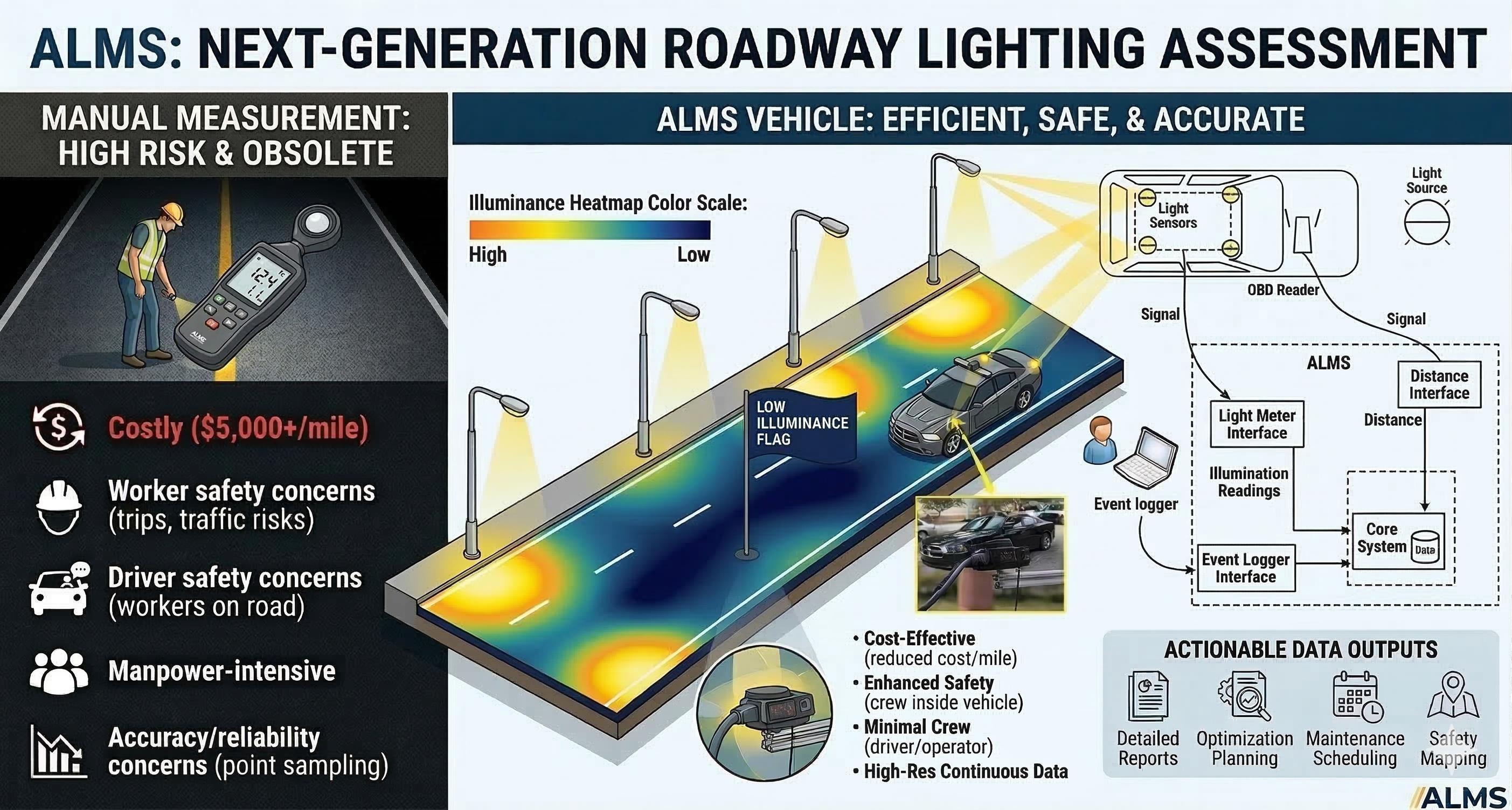
Technical diagram showing ALMS hardware architecture: interconnect between GPS, sensors, and central processing hub

Manual Measurement

  • Costly
  • High worker safety risk
  • Slow data collection (walking speed)
  • Low data resolution
  • Spot checks only
VS

ALMS Automatic

  • 1/20 of traditional cost
  • Zero risk (vehicle-mounted)
  • Highway speed collection
  • High-resolution mapping
  • Network-wide monitoring

Applications

From network-wide assessment to pinpointing crash-prone corridors.

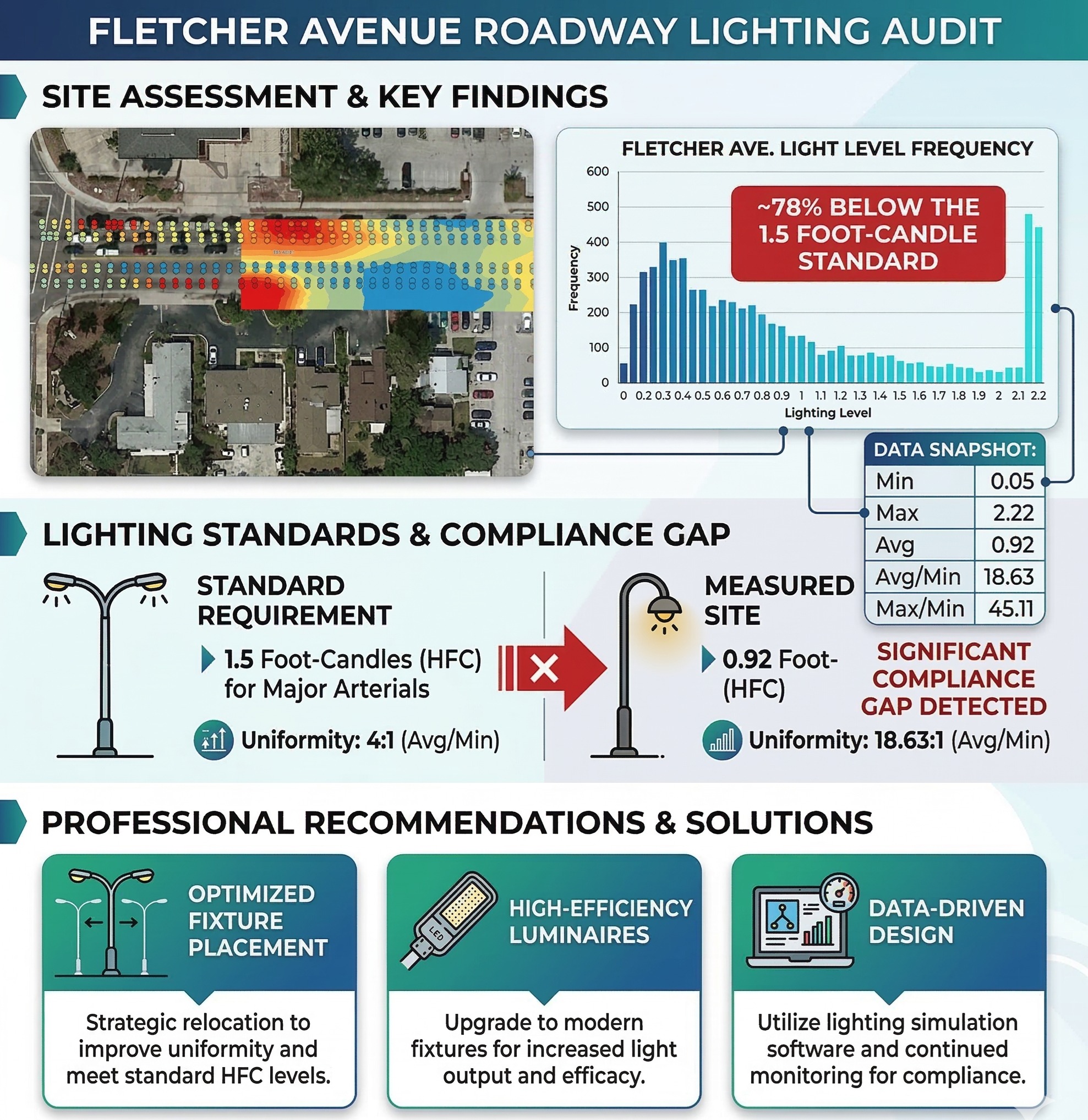
Lighting Level Assessment

  • Review lighting patterns along a corridor or the whole network
  • Visualize lighting patterns using heatmaps and statistics
  • Check if lighting patterns meet transportation agencies' standards
  • Assess the lighting performance of the corridor or the network
  • Identify the spots with poor lighting performance
Visual representation of a lighting audit on Fletcher Avenue, highlighting areas with insufficient illumination

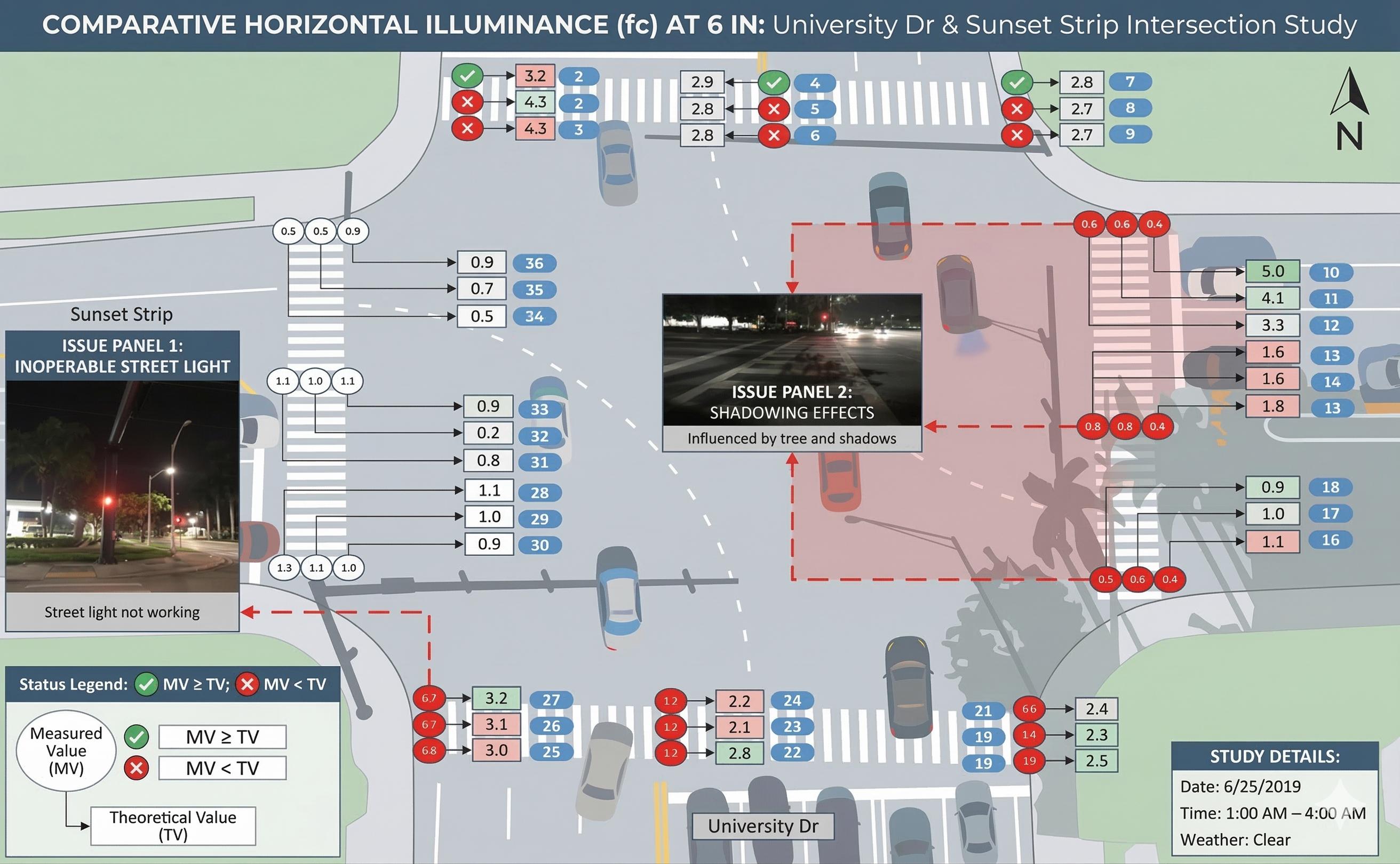
Validate Lighting Retrofits

  • FDOT is conducting lighting retrofit projects at more than 2,000 signalized intersections for pedestrian safety
  • New and reconstructed signalized intersections with crosswalks will have vertical illumination
  • A quality assurance review of intersection lighting retrofits is crucial
  • Validate lighting retrofit design and construction
Data plot comparing horizontal illuminance levels at the University Dr & Sunset Strip intersection, showing high-resolution measurements

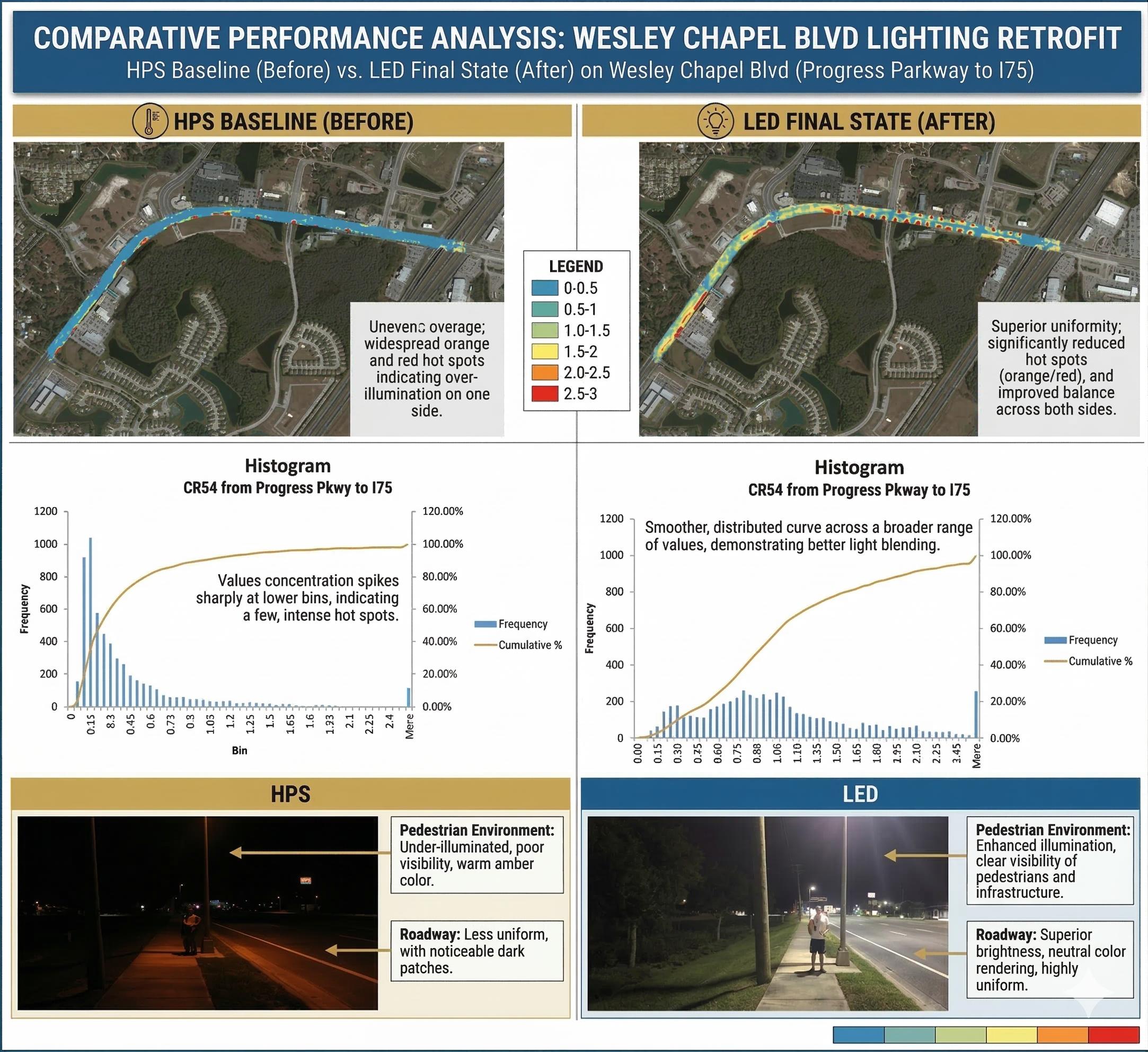
Comparison of LED and HPS

  • LEDs are fourth-generation light sources developed as an energy-efficient alternative to traditional street lighting (HPS)
  • Over 100 intersections and over 10 state roads have been retrofitted to LED streetlights in Tampa Bay in the past 5 years
  • Use ALMS data to evaluate the lighting performance of LEDs on SR56
  • LEDs greatly increase the average lighting levels
  • LEDs greatly improve the uniformity
Chart comparing performance metrics between traditional HPS lighting and modern LED retrofits

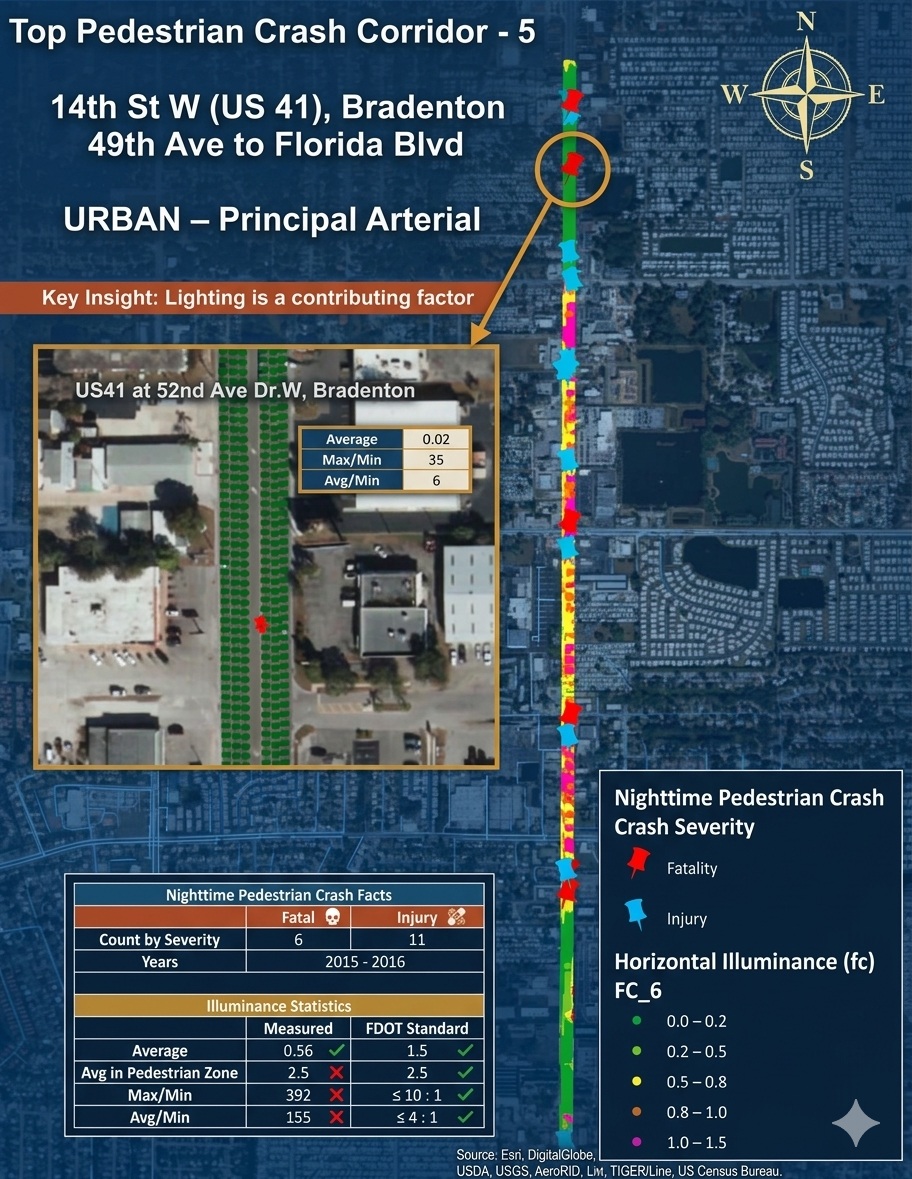
Lighting Diagnosis for Crash Spots

  • Inspect lighting patterns of crash hotspots
  • Determine if lighting is a contributor to crash risk

πŸ“ Case Study β€” Top Pedestrian Crash Corridor

Location: 14th ST W (US 41), Bradenton β€” 49th Ave to Florida Blvd
Status: Top 5 Pedestrian Crash Corridor in Florida
Finding: Poor lighting level (average 0.56 fc)
Lighting is a primary contributing factor
Analysis of lighting conditions at a specific pedestrian crash location to determine environmental factors

Nighttime Safety Management

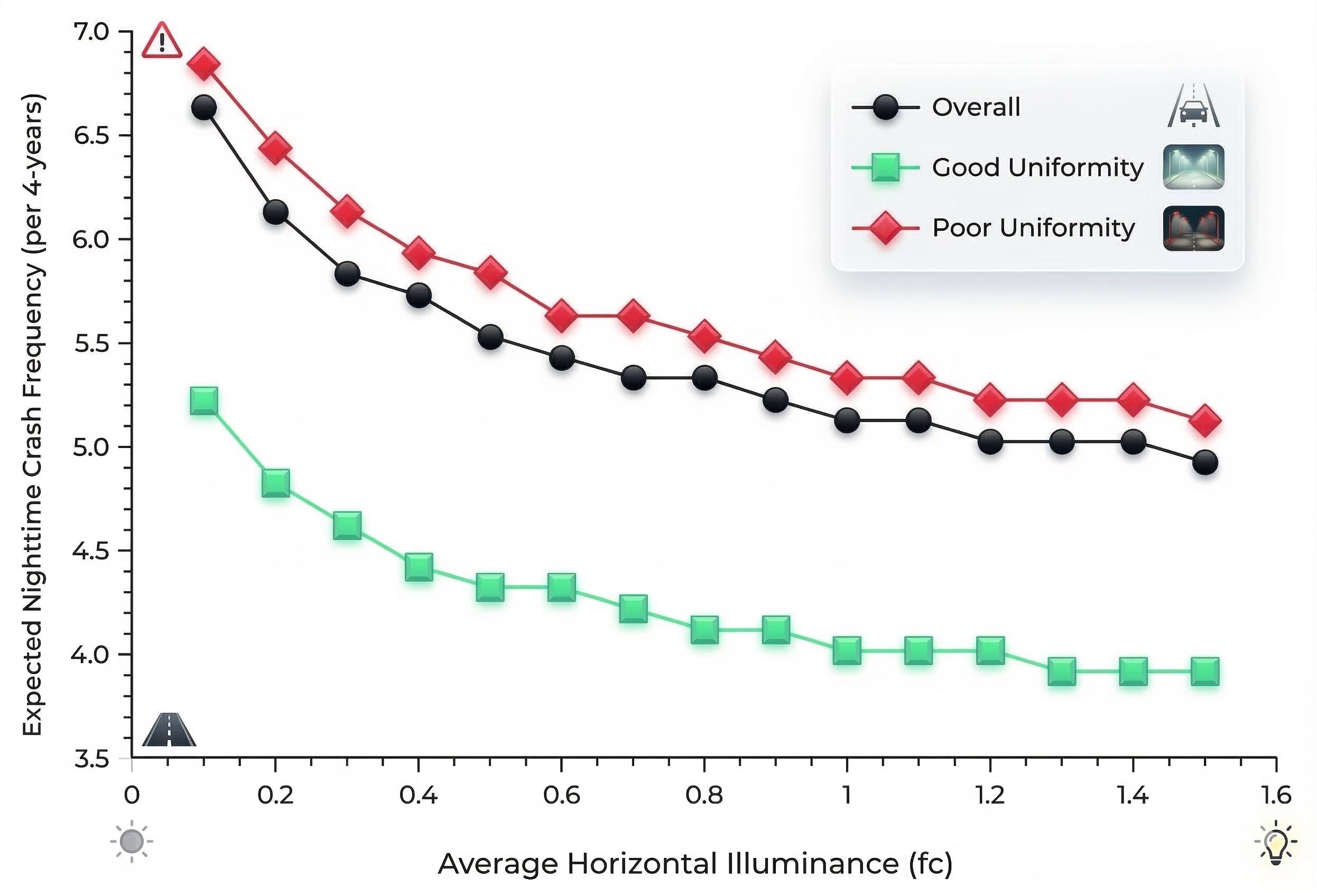
  • Quantify the relationship between nighttime crash risks and lighting patterns
  • Average Lighting Level and Uniformity
  • Safety Performance Functions (SPFs)
  • Crash Modification Factors (CMFs) for vehicle and pedestrian crashes
  • Select and prioritize potential roadway lighting retrofit projects for safety improvement
  • Select road facilities by PSI (potential safety improvement)
  • Estimate crash reduction and benefits of proposed potential lighting retrofit treatments
  • Rank proposed lighting retrofit projects based on benefit-cost ratios
  • Support transportation agencies' decision-making in implementing roadway lighting improvement

Key Metrics

SPFs Safety Performance Functions
CMFs Crash Modification Factors
PSI Potential Safety Improvement
B/C Benefit-Cost Ratios
Visual representation of Safety Performance Functions data used for predictive safety analysis

Milestones & Impact

Over a decade of proven deployment with FDOT and national recognition.

2022 – 2023

FDOT District 7-wide Lighting Level Measurement and Analysis

  • 58 state road corridors
  • 412 center miles
  • 1,945 lane miles
View Interactive Dashboard β†’
2012 – 2021

FDOT District Seven & District One Implementation

  • Completed six phases since 2012
  • 400 center-miles in central and southwest Florida
  • 1.2 million lighting data records
  • Continue to expand lighting data collection
2015
πŸ… National Award

2015 National Roadway Safety Award

  • Major Cost Saving + Protect Worker Safety
  • Collecting crucial data on lighting intensity was labor intensive, expensive, and dangerous
  • Collect continuous roadway lighting measure (CRLM) data
  • Significantly higher quantities of data collected using this safer, more cost-effective methodology
View Award Details β†’
2012

ALMS Development

  • Initial research and conceptual design at CUTR
  • Engineered advanced collection and measurement protocols
2007

Initial Pilot

  • First prototype field testing
  • Proof of concept for mobile lighting assessment

Research

Peer-reviewed journals, conference presentations, webinars, and technical reports.

Downloads

Firmware, data management tools, and the Android controller app.

ALMS Firmware

v3.3.9

Latest firmware for ALMS 3-serial products (Serial number starts with 3). Run the self-extracting file on a Windows PC and follow the instructions. You may need to install the USB driver (CH340G).

Firmware 3.3.9
v3.3.9
  • Reset LEDs when receiving STOP
  • Fix ADS 1x15 library
  • Fix sending "Ready" after reset
v3.3.7
  • Add file close for the STOP command
v3.3.6
  • Add initial reading at zero feet
v3.3.5
  • Add data field of DMI/TIMER indicator in SD outputs
v3.3.4
  • Change default timer interval to 85 ms (for testing)
  • Change the data type of bt_rate in EEPROM to unsigned long
v3.3.3
  • Add Product Model Info (6 characteristics)
  • Fix Serial Reading Errors in 3.3.2

Data Manager

v0.0.6

The ALMS Data Manager is used to download and convert data from an ALMS device. Install on a Windows PC.

ALMSDM 0.0.6
v0.0.6
  • Migrate from .NET Framework 4.7.2 to .NET 8
  • Single exe file, no installation needed
  • Add soft-reset when read system information
v0.0.5
  • Remove popup windows for deleting files

ALMS Controller

v0.2.3

Android app to operate the ALMS device. Download and install the latest APK directly on your Android device. Uninstall old version before installation. Android 5.0+ required.

Controller v0.2.3
v0.2.3
  • Add distance information on Monitor screen
  • Change minimum API Level to 21
  • Build at 12/11/2019
v0.2.2
  • Add display of product model information
  • Build at 12/10/2019
v0.2.1
  • Add display of system information
  • Change API Level to 29 (target) and 24 (minimum)
  • Build at 12/09/2019

USB Driver (CH340G)

Required

Install the USB driver before connecting an ALMS device to your Windows PC.

Dashboard